
Decorated perfume bottles fail in recognisable patterns — colour drift, misaligned print, foil wear, cap fit — and every pattern is catchable at a checkpoint before it becomes a batch problem. Quality control for decoration is a sequence of gates, each with a pass criterion and a record, rather than a single inspection at the end of the line. A brand that installs the gates early gets consistent bottles; one that trusts the first sample gets the surprise at volume.
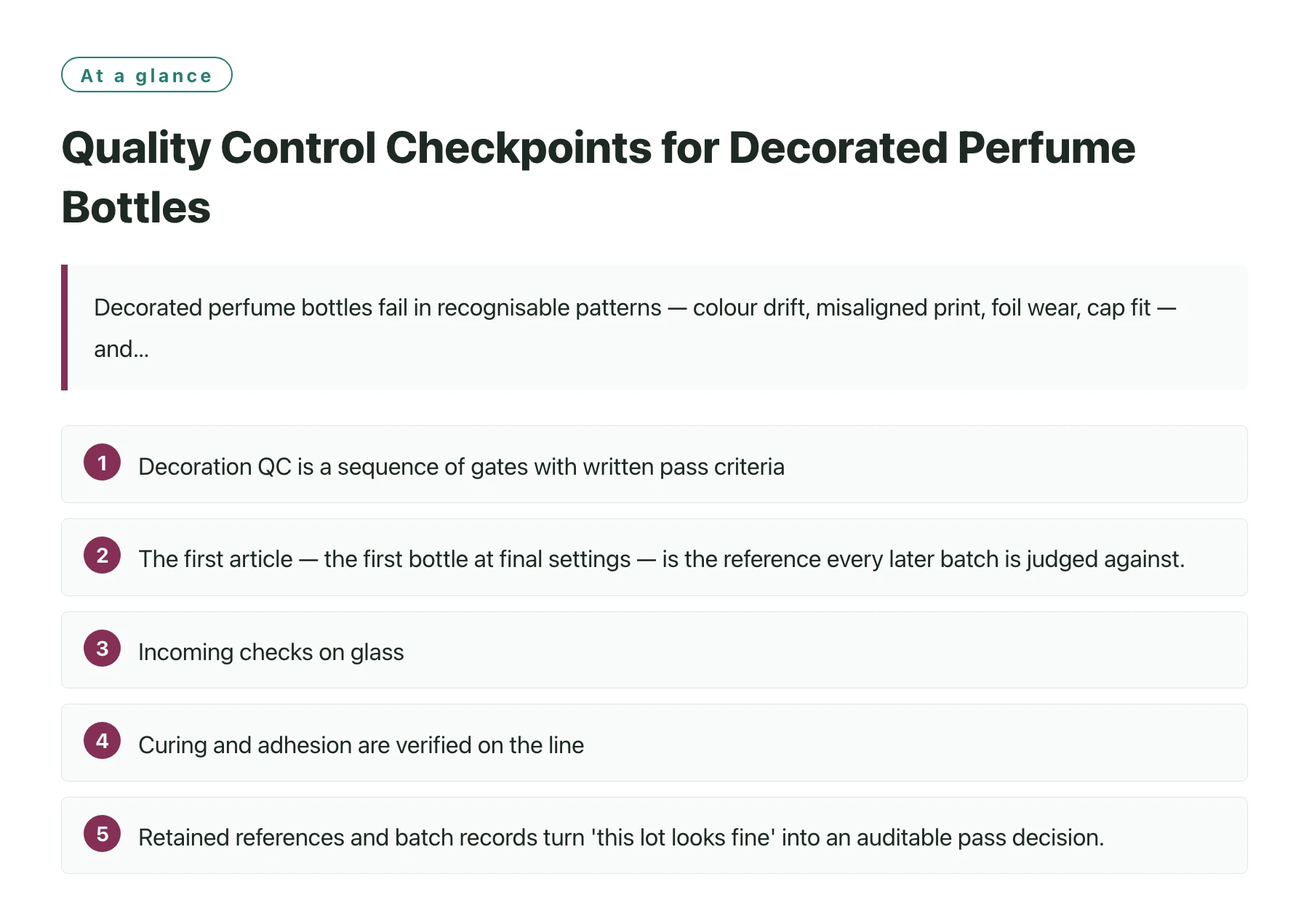
Key takeawaysDecoration QC is a sequence of gates with written pass criteria, not one final inspection. · The first article — the first bottle at final settings — is the reference every later batch is judged against. · Incoming checks on glass, caps and inks catch the problems that decoration itself cannot fix. · Curing and adhesion are verified on the line, because a bottle can pass visually and fail in the pocket. · Retained references and batch records turn 'this lot looks fine' into an auditable pass decision.
Most decoration defects are not discovered at the factory; they are discovered at the first retail return, by which time they are a batch problem rather than a sample problem. The fix is not stricter final inspection — it is checkpoints placed where the defects are actually born.
The gates below form the standard sequence: incoming materials, first article, in-line checks, curing, retention and outgoing inspection. Each gate has one question, and the answer to that question is recorded.
Where decoration defects actually come from
From the glass and caps, before any printing
Bottle blanks vary in colour, surface and dimension between glass batches, and caps vary too. If the incoming glass is off-spec, no amount of printing skill fixes it. The first gate is therefore incoming inspection: blank colour, surface condition and the cap's fit before anything is decorated.
From the set-up, not the operator
Repeatable decoration is a set-up achievement, not an operator miracle: the quality lives in the screens, foils, masks and machine settings. The gate is a signed set-up sheet plus a first article, which is why the same line produces consistent output for years and inconsistent output the day its procedures are skipped.
From the interface between parts
The classic defects sit where parts meet: print running into the cap, the label colliding with the pump, foil rubbing where the hand holds the bottle. Only the first-article inspection sees the bottle whole, which is why it is the one gate that cannot be delegated to a single station check.
The checkpoint sequence
- Incoming inspectionGlass blanks, caps and materials are checked against the approved specification and the certificate of analysis before the line starts.
- First-article approvalThe first decorated bottle at final settings is compared with the approved reference — colour, placement, alignment, adhesion, cap fit — and signed by both sides.
- In-line monitoringColour, position and coverage are checked at set intervals during the run, so drift is caught in minutes rather than in batches.
- Curing and adhesion verificationAfter drying or curing, rub, alcohol and tape tests confirm the finish will survive handling, not just the shelf.
- Retention sampleA sealed bottle from the batch, dated and labelled, is kept beside the approved reference for future comparison.
- Outgoing inspectionSampling over the packed batch — visual, dimensional and functional — checks the whole before the cartons leave the factory.
- Batch recordAll gate results are compiled into one record per batch, so 'approved' means the file, not the impression.
The gates, the check and the record
| Gate | What is checked | Record produced |
|---|---|---|
| Incoming | Glass colour, surface, cap fit | Incoming inspection report |
| First article | Colour, placement, adhesion, fit vs reference | Signed first-article approval |
| In-line | Colour and position at set intervals | In-line check log |
| Curing | Rub, alcohol and tape adhesion | Curing verification sheet |
| Retention | Sealed reference from the batch | Retained-sample register |
| Outgoing | AQL-style sampling of packed batch | Outgoing inspection report |
| Batch record | All gates compiled per batch | The batch file |
The pattern is worth noticing: every gate produces a record, and the records are the point. A QC sequence without records protects the batch; the same sequence with records protects the brand across every future reorder.
Turning the gates into a standard you can enforce
Each gate needs three things to work: a written pass criterion, a named responsible person and a record. Without the criterion the gate runs on opinion; without the record the next order cannot be compared with this one. Both failures are invisible until a dispute, which is exactly when they are most expensive.
Decoration QC also sits next to the fragrance's own release checks. The finished product will be tested for stability, microbiology and safety before release, and the decorated bottle adds adhesion and material-compatibility questions to that plan [1]. The formula's compliance is verified separately against the industry's published use restrictions and the factory's checking process [2], so the formula file and the decoration file are two halves of the same release decision.
Premium lines lean on this discipline hardest: a brand positioning at the premium end needs its bottles indistinguishable batch to batch, which is why premium production runs carry QA as a built-in feature rather than an afterthought premium fragrance OEM and QA.
Choosing a line with the gates already installed
A factory's QC discipline is visible before you sign: ask where the decoration gates sit, who signs the first article and what a batch record contains. A house that has run decorated perfume lines for years — such as Xuelei Perfume with its Guangzhou production — can walk a visitor through the gates from memory, because the sequence is routine rather than policy.
The same conversation reveals the factory's attitude: a partner that treats the first article as a formality will treat the batch record as a favour. Both are ordinary parts of the job for a manufacturer that runs QC as a documented sequence, and both are early signals of what the next two years of reorders will look like.
Sources
- SGS: Cosmetics, Personal Care & Household Testing —— Testing, inspection and certification services for cosmetics and personal care, including microbiological, stability and safety testing aligned with cosmetics GMP.
- IFRA Standards Library (International Fragrance Association) —— The IFRA Standards Library lists the restrictions the fragrance industry applies to individual fragrance ingredients, based on safety assessments; it is the reference point for compliant fragrance formulation.
Frequently asked questions
What is the most common decoration defect?
Colour drift between batches and misaligned print are the two most common complaints, followed by foil wear on handled surfaces. All three are catchable at in-line checkpoints and the first-article gate, which is why the gates exist.
Who should sign the first article?
Both sides — the factory's production or QC lead and the brand's representative. The signature makes the approval a fact with a date rather than an impression, and it is the reference for every later batch.
Do I need a third-party laboratory for decoration QC?
Not for every check. In-line and first-article checks are factory work; adhesion and material tests can be run in a third-party laboratory when the brand wants an independent record, and cosmetics testing aligned with GMP covers the finished packaging.
What should a batch record contain?
The raw material intakes, the set-up sheet, the in-line check log, the curing verification, the retention sample reference and the outgoing inspection result. A complete batch record lets anyone reconstruct what happened to that batch weeks after it shipped.
How do I handle a batch that fails a gate?
Stop the line, quarantine the batch and return to the set-up sheet. The question is not only what failed but which gate was supposed to catch it earlier — fixing the gate is what prevents the same failure in the next batch.